For years, beginner paragliders have followed a familiar formula.
Make them safe. Make them forgiving. Make them durable enough to survive endless training hill abuse. Then accept that pilots will probably want something more exciting within a season or two.
The result? Many student wings are excellent at helping people learn, but not necessarily at keeping them inspired once the training course ends.
The new NOVA NIVO appears to challenge that idea.
Instead of building another traditional school wing, NOVA has created a glider that aims to accompany a pilot from their very first inflation all the way to thermal flights, SIV courses, and even the first tentative steps into cross-country flying. Positioned between the classic school-oriented PRION and the more performance-focused AONIC, the NIVO fills a gap that many manufacturers have largely ignored.
The question is simple:
Can one wing genuinely serve both the nervous student and the newly licensed pilot hungry for adventure?
After examining the design philosophy behind the NIVO, the answer appears surprisingly convincing.

First Impressions: This Doesn't Look Like a Typical School Wing
The first thing that stands out is NOVA’s intent.
The company repeatedly describes the NIVO as “more than a student glider,” and unlike many marketing slogans, the claim is reflected in the design choices. Instead of pursuing the absolute simplest structure possible, NOVA deliberately increased the wing’s complexity to improve handling, precision, and thermal performance while maintaining EN-A certification.
The wing features:
- EN-A certification
- 40 cells
- Aspect ratio of 4.87
- Weight starting from 3.75 kg
- Certified weight ranges from 54 kg to 130 kg depending on size
Those numbers may not sound revolutionary on paper, but together they reveal the philosophy behind the wing.
NOVA wasn’t trying to build the safest possible wing at the expense of everything else.
They were trying to build the most complete beginner wing possible.
Who Is The NIVO Really For?
The obvious answer is student pilots.
But that would be selling the wing short.
The NIVO is arguably best suited to three distinct groups.
1. Pilots Currently Learning
For schools and instructors, predictability is everything.
Students make mistakes. They overcontrol. They react late. They occasionally do the exact opposite of what they should do.
The NIVO is designed to absorb many of those mistakes without creating new problems. NOVA specifically developed it to support learning progression through forgiving reactions and calm behavior.
This makes it attractive for training environments where consistency matters more than outright performance.
2. Freshly Licensed Pilots
This may actually be the NIVO’s sweet spot.
Many new pilots finish training only to discover their school wing feels limiting once they start chasing thermals and longer flights.
The NIVO seems intentionally built for that transition period.
Instead of encouraging an immediate jump to a low-B, it offers enough handling precision and efficiency to keep a pilot interested while remaining firmly within the comfort zone of an EN-A.
3. Recreational Pilots Who Prioritize Simplicity
Not everyone wants to become an XC addict.
Many pilots simply want a wing that launches easily, thermals efficiently, and doesn’t demand constant attention.
The NIVO appears well suited to that category as well.
For pilots who value confidence over complexity, it may offer a refreshing alternative to the endless race toward higher classifications.

The Most Interesting Part: How It Flies
Specifications never tell the whole story.
What matters is the feeling transmitted through the risers and brakes.
NOVA repeatedly emphasizes “harmonious handling” when describing the NIVO, and that phrase is important. Rather than aiming for ultra-light brake pressure or sporty reactions, the wing appears designed around clarity.
The brake pressure reportedly builds progressively and predictably, giving the pilot a clear understanding of what the wing is doing without feeling nervous or twitchy.
That matters enormously in thermals.
Many beginner pilots struggle not because they can’t find lift, but because they can’t interpret what the wing is telling them.
A wing that communicates clearly can accelerate learning far more effectively than a wing with marginally better glide performance.
According to NOVA, the NIVO also offers low sink rates in turns and helpful thermal feedback, making it easier to center lift and remain efficient while climbing.
In practical terms, that means less fighting and more understanding.
And understanding is what eventually creates good pilots.
A Wing That Wants To Grow With You
This is perhaps the strongest argument in the NIVO’s favor.
Most pilots remember their first wing.
Very few remember it fondly.
The typical beginner wing is purchased with the expectation that it will soon be replaced.
NOVA seems to have designed the NIVO differently.
The company explicitly states that the wing is intended to remain useful well beyond training, supporting thermal flights, first XC attempts, and continued skill development.
That longevity could make the NIVO particularly appealing for pilots who don’t want to buy another glider within a year.
What About SIV And Progression?
One unexpected feature of the NIVO is its progression potential.
NOVA highlights that the wing is suitable for introductory maneuver training and first SIV experiences. It even mentions maneuvers such as full stalls, SATs, helicopters, and misty entries as part of the wing’s learning pathway.
That doesn’t mean the NIVO is an acro wing.
Far from it.
What it suggests is that the glider provides clear enough feedback and predictable enough reactions for pilots to safely begin exploring advanced skills under professional supervision.
For many pilots, that is exactly what an EN-A should do.
Not prevent progression.
Enable it.

Durability Matters More Than Marketing
One area where NOVA deserves credit is practicality.
The NIVO is built using relatively robust materials and is specifically intended to withstand the realities of training environments.
Wet morning takeoffs.
Dusty landing zones.
Repeated ground handling.
The endless abuse that student wings inevitably endure.
While lightweight gliders often dominate marketing conversations, many instructors quietly prefer durability.
A wing that survives thousands of inflations often delivers more value than one that saves a few hundred grams.
The NIVO appears to strike a sensible balance between weight, packability, and longevity.
What Pilots Will Probably Like
Based on the design philosophy and available information, the NIVO’s strongest qualities appear to be:
- Confidence-inspiring launch behavior
- Clear and progressive brake feel
- Strong thermal learning platform
- Genuine post-school usability
- High durability
- Forgiving reactions during progression training
- Enough performance to delay the urge for an immediate upgrade
Potential Limitations
No wing is perfect.
Pilots seeking maximum glide performance, aggressive XC ambitions, or dynamic handling will eventually outgrow the NIVO.
That’s not criticism.
It’s simply the reality of the category.
The wing remains an EN-A, and physics still applies.
A pilot focused on long-distance competition flying will ultimately move toward higher-performance categories.
The NIVO’s mission is different.
Its mission is to help pilots become good pilots.
Final Thoughts
The paragliding industry often treats beginner wings as temporary equipment.
Something to survive.
Something to replace.
The NOVA NIVO takes a different approach.
It feels like a wing designed around the idea that the early years of flying should be enjoyable, not merely safe.
Yes, safety remains central to the design.
But equally important is the sense that the pilot is flying a real paraglider rather than a watered-down training tool.
For students, it offers forgiveness.
For newly licensed pilots, it offers room to grow.
For instructors, it offers peace of mind.
And perhaps that combination is the NIVO’s greatest achievement.
It doesn’t ask, “How safe can an EN-A be?”
It asks a more interesting question:
“How far can an EN-A take you before you ever feel the need to leave it behind?”

Colours That Actually Look Like Flying Wings
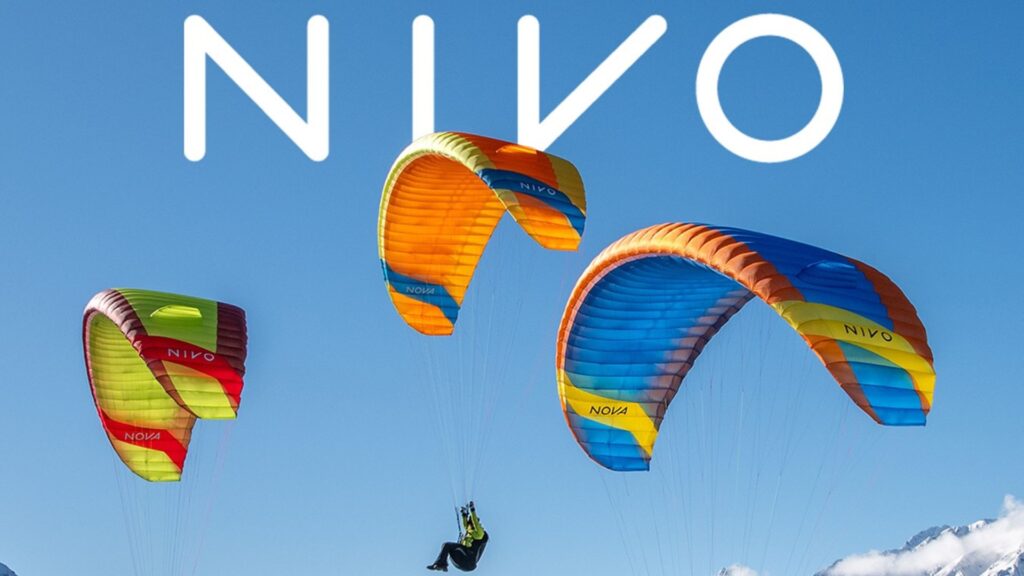
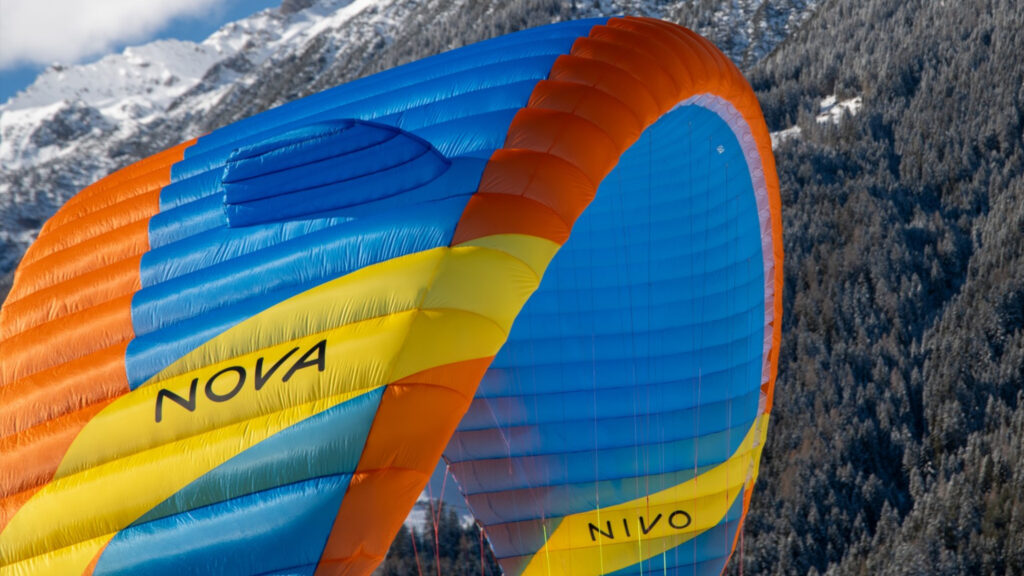
One thing NOVA has always done well is colour design. The NIVO continues that tradition with a range of combinations that are easy to identify in the sky while still looking modern and distinctive on the ground. Available standard colour schemes include Blue-Grey, Green-Sangria, Lime-Orange, Orange-Blue, Orange-Sangria, Orange-Tapestry, and Red-Lime, giving pilots plenty of options whether they prefer understated elegance or something more vibrant. Custom colour options are also available for those wanting a more personalised wing.
For many pilots, colour is more than aesthetics. It becomes part of a wing’s identity. Years later, pilots often remember their first glider not by its model name but by its colours. The NIVO’s palette feels modern, fresh, and unmistakably NOVA.
Available in India Through Temple Pilots
Indian pilots interested in the NOVA NIVO can purchase and receive support through Temple Pilots, one of India’s most established paragliding schools and equipment providers. With over 25 years of paragliding experience, Temple Pilots offers guidance on sizing, wing selection, progression pathways, and after-sales support, helping pilots choose the right equipment for their flying journey.
Choosing a glider is rarely just about specifications. Access to knowledgeable instructors, test opportunities, and long-term support often proves just as important as the wing itself. For Indian pilots considering the NIVO, having local expertise available makes that decision considerably easier.
A small SEO-friendly line you can also place at the very end:
Temple Pilots is an authorised NOVA dealer in India, offering the complete range of NOVA paragliders, harnesses, reserves, and accessories, along with expert guidance from experienced pilots and instructors.