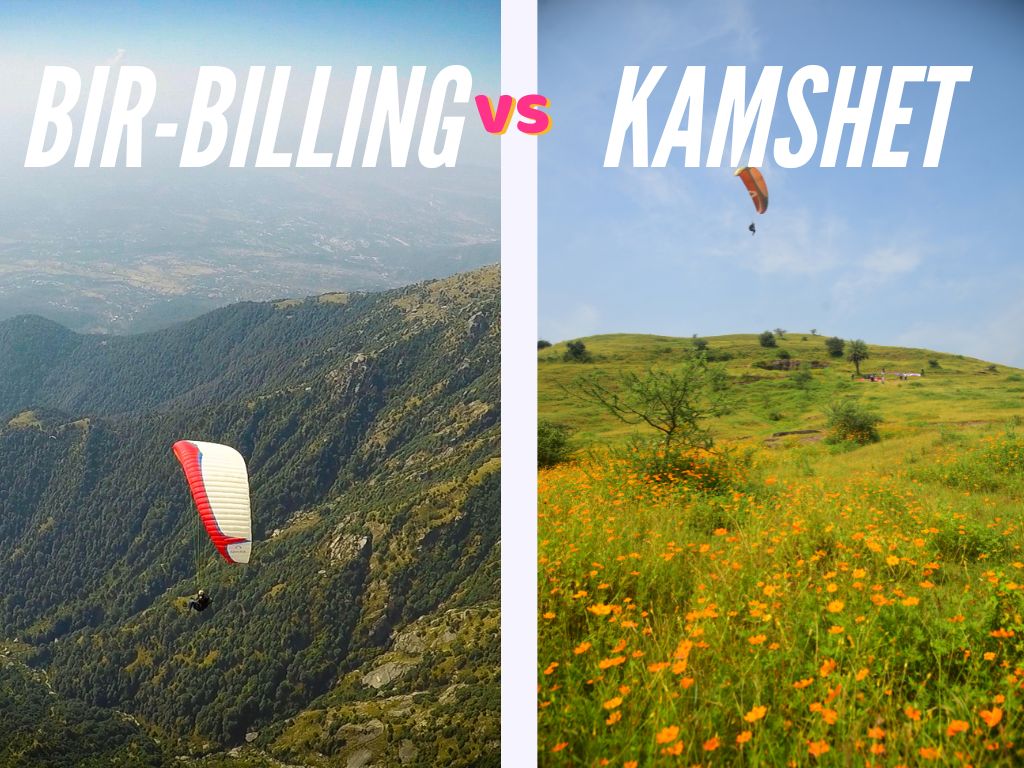
If you’re new to paragliding, one of the first questions you’ll encounter is:
“Should I learn paragliding in Bir or Kamshet?”
In our detailed guide on Bir vs Kamshet, let’s find out the answer for this question.
At first glance, the comparison seems simple – Bir is famous, Kamshet is quieter.
In reality, the two sites represent very different flying environments, shaped by geography, weather systems and flying style.
Kamshet is in the Sahyadri mountain ranges, influenced by coastal winds and has more predictable & reliable weather systems. Paragliding Training here focuses on basic training, ridge soaring, extensive ground handling, and progressive thermal flying – making it well suited for building strong foundational skills for launch, landing, and control fundamentals from basic to advanced levels.
Bir, on the other hand, is a high-mountain Himalayan site, with a primary take-off around 8,000 ft above sea level, making it one of the highest paragliding launch points in the world. It is dominated by thermic conditions and valley winds and is an outstanding place to fly – but it demands higher pilot skill levels, safe decision-making, airspace awareness and good comfort & experience with high altitudes.
Both sites are excellent.
They are simply designed for different phases of a pilot’s development.
This comparison is not about scenery or popularity.
It is about how training environments shape learning, safety and long-term flying habits.
Bir sits high in the Himalayas, with a single launch & landing site, high altitude mountains, deep valleys and committing terrain.
It is inspiring – but unforgiving.
Kamshet, by contrast, offers multiple flying sites suited to different wind conditions and pilot levels, with rolling hills, friendly training slopes and higher mountains introduced progressively.
Training hills & slopes in Kamshet allow pilots to build solid skills & confidence progressively. For beginners, forgiving terrain matters. Learning requires space to fail safely.
Learning is easier when the weather is more predictable & reliable
Bir offers strong thermic conditions ideal for cross country flying for experienced pilots. They are fantastic once a pilot understands them, but for someone still learning launches, landings, and wing control, such conditions will demand much higher skills & mature judgment.
Flying in thermic conditions requires advanced skills, including high active-piloting skills and sharp decision-making abilities that the beginner pilots are still developing.
Kamshet’s ridge soaring conditions are smoother and more predictable, especially in the mornings & evenings. This consistency allows instructors to teach fundamentals without taking unnecessary risks & rushing progress.
Confidence builds best when exposure increases gradually.
A first solo flight is meant to consolidate fundamentals – an easy launch, calm control, a simple planned approach, and an accurate landing – in an environment where risk can be easily managed and corrected.
First solo flights from extremely high take-offs, sometimes among the highest used for training globally, may look impressive or tempting for social media, but they introduce height, commitment, and consequence all at once without adding learning value. This can sometimes be counterproductive for student-pilots who are introduced to high altitudes without any previous familiarisation at lower altitudes.
The height removes the possibility of instructor intervention once airborne, increases psychological load, and significantly reduces safety margins. For a beginner, this limits gradual confidence building and eliminates the short feedback loops that are critical for safe, effective training.
In aviation, safety is built through progressive exposure and repetition; height and complexity should be introduced only after control, judgment, and emergency handling are reliable – not before.
In Kamshet, solos begin low and grow progressively. Landing areas are typically visible from launch, helping students visualise the full flight before leaving the ground and adapt mentally and technically before being exposed to longer, more committing flights.
Paragliding is learned through hundreds of small decisions, not one big flight.
Bir’s geography limits repetition – fewer launches per day, longer flights, and fewer opportunities to reset.
Kamshet allows repeated ground handling, followed by hops, mini-flights, and short solos, with height and complexity introduced through a clear, gradual progression. This repetition is where muscle memory, timing, and judgment are formed.
Less traffic means more learning bandwidth & higher Safety
Bir is an internationally known paragliding site, having hosted world-level competitions and attracting pilots from across the globe. As a result, it is often busy – Hundreds of Tandems, XC pilots, and visiting international pilots frequently share the same airspace. The launch & landing are overwhelming, especially in the best flying season of October & November. For a new pilot, this increases mental workload and distraction.
Kamshet’s training sites are more controlled, with clearer separation between students, certified tandem pilots, and experienced pilots following ridge rules. Radio communication and instructor supervision are easier to manage.
Learning benefits from time, not pressure*
Bir’s flying season is relatively short and intense, often forcing students to rush training or pause progression until the following year.
Kamshet offers the longest paragliding learning season in India, typically from October to May. This allows continuous learning, structured batches, and proper progression from P1 to P3 without rushing.
At Bir, the landing zone is not visible from the East take-off. Beginners must rely entirely on radio communication, briefing, memory, and judgment for their approach, often before they have enough experience to visualise a full landing circuit.
In Kamshet, landing areas are always visible from launch. This helps students mentally map their flight, understand approach geometry, and receive real-time feedback from instructors on the ground.
Once a student launches from a high take-off, instructor intervention is limited. The flight must be completed even if the student struggles mid-air.
In Kamshet, shorter flights allow instructors to stop, brief, correct, and repeat immediately. Errors are contained, debriefed, and retried within minutes – turning mistakes into learning opportunities & moments instead of stress events.
Errors in Bir can compound quickly due to height, terrain, and wind strength. A small mistake early in the flight may grow before recovery is possible.
In Kamshet, errors are contained. Students can land, debrief, and try again within minutes – turning mistakes into learning opportunities & moments, instead of stress events.
Bir demands early understanding of layered winds, valley effects, traffic management, and long glide planning. This creates a high cognitive load for beginners still mastering basics.
Kamshet introduces decision-making progressively. Early flights focus on control and awareness, with complexity added only when the student is ready.
Because of terrain, conditions, and traffic, Bir carries a higher inherent risk for fresh pilots. Errors are less forgiving.
Kamshet offers a lower-risk environment where mistakes are expected, managed, and corrected – exactly what a learning environment should provide.
Bir is not “bad for learning.”
It is simply not a beginner-first friendly environment.
Bir shines when:
Launches and landings are already consistent
Comfort with height and airspace is established
The pilot is ready for thermalling, XC, and high mountain flying
It is a powerful next step – not the first one.
Bir’s pull is undeniable. It’s scenic, famous, and highly visible on social media. The idea of “big mountain flying” is aspirational.
But these are perception drivers, not learning advantages.
Bir inspires pilots.
Kamshet builds them.
If the goal is to become a safe, confident, independent & a competent pilot, fundamentals need time, repetition and a controlled learning environment.
Start in Kamshet.
Go to Bir when you’re ready to use it fully.
This way you make the best of both, with higher safety & real competence & confidence